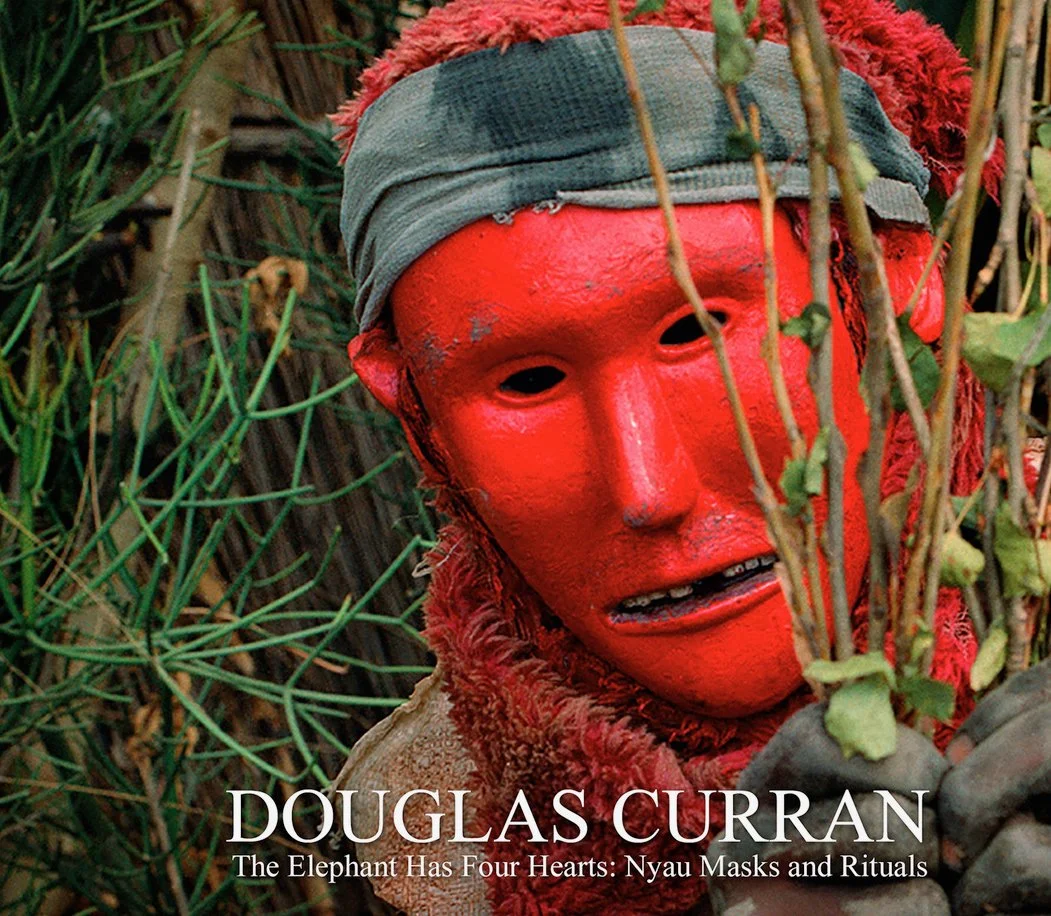
Exhibtion Catalogue
The Elephant Has Four Hearts: Nyau Masks and Ritual
"A nyau is driven by spirits...Nyau dancers are not human beings - they are spirits." Chief Lenifodi Chitule, Chitule village, 2002
There are no signs to indicate the way to the sacred grove. As one draws nearer to a dense, overgrown grove, a sharp eye might notice a few shreds of torn fabric or a broken feather scattered on the beaten dirt path. On the last turn, just before stepping into the mottled light of overgrowth, a single strip of red cloth - a warning - is strung overhead across the pathway. Without purpose or being able to ‘sign’ the coded language and secret knowledge of those who have been initiated into the spirit society, a passersby will not take those last few steps into the dambwe.
Upon approaching a stream or river in rural Malawi, the polite form is to call out ‘Ku madzi’ (to the water) to alert anyone who might be bathing there of your approach. It is the same on entering the dambwe. One calls out ”Ku madzi!”, both as a warning to those who might be inside, but also as a benediction, a call to the spirits, to the origins, the source, to the sacred pool. “Madzi ndi moyo” the Chewa say; ‘Water is life.’ and this reality is reflected in key elements of the nyau practice. The spirits, one is told, are fished out of a pool at the centre of the sacred grove, by elders using eggs as bait. Blindfolded initiates are forced to undergo a symbolic birth, calling “Mira! Mira!” (Sinking, sinking!) as they crawl, blindfolded on hands and knees into the belly of Kasiyamaliro, to be reborn as adults, shed of their childhood.
As the photographic work of this project has extended and the annual trips to Malawi continue many people ask, “When will you be finished?” The truth has been that I haven’t wanted it to finish. I’ve enjoyed my sinking into the people, the culture and the ensuing richness of details and subtlety that have come from the repeated trips and that familiar relief of taking the last turn onto the dirt road leading to Mua.
The time I spent among the Chewa has been a rare privilege; to be part of what is essentially a pre-literate world. I say that guardedly since many might term it denigrating, implying a lack of ability or capacity on the part of Africans in general and the Chewa in particular. Far from being a criticism, the opportunity to be with people of rural Malawi informed me of a broader awareness of what it might mean to be human, of another way of interacting in the world, of injecting oneself into one’s own life. But, I may be getting ahead of myself and need to go back a little.
It started with a black man in a homburg hat...
"Zima Chitika"/It happens: The Death of John Kanjadza
The phone call reached me the night before driving out of Nelspruit, South Africa, alone, for the 3-day push through Mozambique to Malawi and the Nyau. “John is dead, Douglas” Martin’s voice spoke, ”It was sudden and he didn’t suffer too much. It is too much to tell now. Just come up and we will deal with things when you arrive. Don’t rush - the funeral was two days ago.”
Driving the 2,300 kilometres through the broken blacktop and dirt roads of the African bush, I had time to remember and reflect on John, his life and our connection. John was a sweet, intelligent man who eagerly took to our work, travelling together throughout remote villages of Malawi with Chief Chitule, photographing the masked spirit dancers of the Nyau.
On our first meeting, I had explained to him the work I wanted to do, and how I hoped to carry it out. After describing the work and showing him the earlier images from Zimbabwe, I laid out each piece of gear, camera, lenses, light stands, strobe lights, naming each piece in turn, then assembling the light box, erecting the light stands, opening the tripod, and mounting the camera to its head. I asked John try his hand at erecting the light stands – an apparatus he had never seen before. He pulled the stands from their bag, fixed the strobe heads, opened the tripod, adjusted the height and stood back beaming, clearly pleased with himself and deeply impressing me with his ability to deal with these unfamiliar and delicate tools that, if broken, could never be replaced in the African bush.
Together with Chitule we quickly formed a strong bond, self-christened the “Three Guys of Gule” as we pushed – and sometimes lifted - a battered Toyota sedan over dry stream beds and rutted tracks, arranging “kumema” the commemorative funeral rites that would provide the structure under which we could summon the Nyau spirits from the World of the Dead, to create their portraits.
Our excursions attracted wide-eyed children entranced by the mystery and metallic glint of the photo equipment. John would speak softly and confidently to them in his newfound role as master of the equipment, and soon his abilities stretched from the technical to the aesthetic as he began to discern which sections of the dambwe (sacred grove) would most aptly serve as backdrop for the masked figures we were documenting...
Kachindamoto, Dedza District, Malawi 2002
A letter from Mua, Malawi
I saw the scorpion slip down the windowsill, behind the curtain, before I could raise a shoe. For days I had stepped widely around the black nylon duffel bag in the corner, the natural habitat for a scorpion. Found him this morning, dead, wedged between folded shorts in the closet.
On the door knob is a moth, yellow polka dotted head on white, with flame-red zigzags on white wings, overlaid with black polka dots. Four-inch long, brilliant green grasshoppers spread their wings to reveal broad bands of cerulean blue merging into magenta and yellow.
Rhinoceros beetles display stripes of metallic lapis lazuli against coal black and just above them dragonflies in velvet Chinese red scoop mosquitoes out of the air.
Along the highway to Blantyre, young boys wave bamboo racks of roasted three-inch cockroaches, the season for smoked mice, artfully arranged with perfectly curled tails, having passed. Last year three passengers on the Lilongwe bus were poisoned by Warfarin-poisoned mice, caught more efficiently than with the usual whack with a stick.
At night, talking with Father Boucher, our conversation is broken by the clattering rush of thousands of wings against the windows and screen door. The white termites - flying ants, are migrating in advance of the mating and rainy season. We push out the door and place bamboo mats on the ground beneath the night light, and with scooped handfuls of water, splash and down hundreds and thousands of them when the water hits their wings. Some having already shed their wings, begin mating - interlocked pairs, menages-a-trois, whole chains of copulating termites. I toss some through the bars of the mongoose's cage and he eagerly snaps them in mid air, snorting in wild delight.
We sweep the downed termites into basins of water where they drown and release their wings. In the morning the gossamer wings are floated off the top and we fry the bodies in their own fat with a pinch of salt, the crunchy bodies tasting of shrimp and bacon.